Key points
- According to the World Health Organization, physical activity is critical for the mental health of people over 65 years of age.
- Physical activity can occur indoors or outdoors, in a group setting or individually, and may involve leisure-time activities such as dancing and gardening that may be personally meaningful to the individual.
- Physical activity programs that may lead to positive mental health outcomes for people include yoga, moderate aerobic exercise combined with music therapy, exergames such as Wii Fit, and mind-body exercises which combine body movement with slow breathing, meditation, and relaxation.
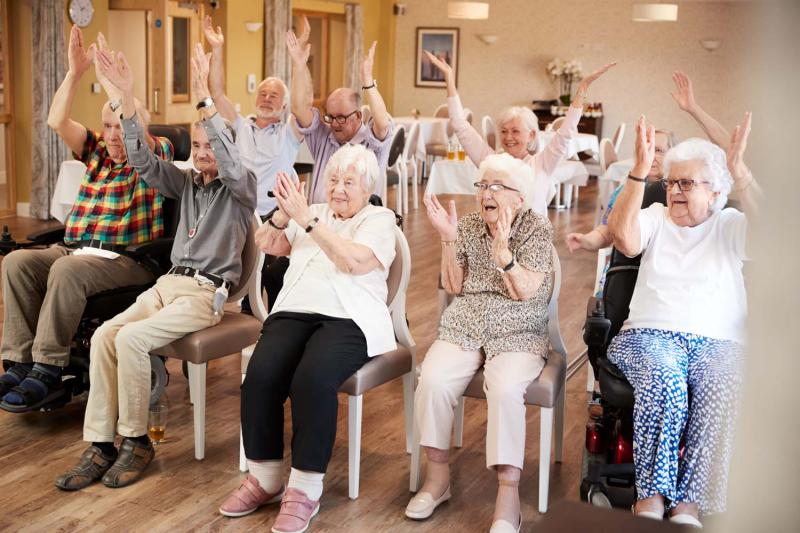
- Chair-based exercises can result in positive psychological responses in people no longer able to exercise in a standing position. This includes people with mobility impairments, frail older adults, some people living with dementia, and the very elderly.
In its 2020 guidelines on physical activity and sedentary behaviour, the World Health Organization (WHO) recommended that all adults aged over 65 years, even those with mobility issues, undertake moderate or higher-intensity exercise three days per week. [1] Ideally, this should include a combination of exercises for balance, strength, endurance, and physical function training. [1] WHO also states that physical activity is critical for the mental health of people aged over 65 years. [1] Current research evidence tends to support this, with exercise now widely considered a beneficial therapeutic approach for managing mental health conditions in people of all ages. [2, 3] For older people, physical activity appears to improve psychological wellbeing and reduce depression, [4] especially when it is of moderate intensity, group-based, [5] and incorporated into everyday life. [6]
Physical activity might be used to increase a person’s overall daily activity level, or it might be prescribed by a physiotherapist or exercise physiologist at a specific intensity and duration to target functional abilities that need improving or maintaining. [7] For older people, physical activity does not need to take place in a formal setting. It can also include leisure-time activities such as walking, dancing, gardening, and even certain types of gaming. These activities may be personally meaningful and bring greater social and psychological benefits than repetitive exercises alone. [8]
This evidence theme on physical activity is a summary of one of the key topics identified by a scoping review of mental health and wellbeing in aged care research. If you need more information on this topic, try using the PubMed search below.
We found 13 reviews focused on the effect of physical activity on the mental health and wellbeing of older people. Most of these included participants living in a residential aged care facility. One review ranked physical activity as one of the two most effective non-drug approaches to improving mental health in the older population, along with psychotherapy. [7] It suggested that exercise worked by increasing social interaction and providing people with a sense of accomplishment. [7] Another review reported that while some studies found that exercise interventions reduced symptoms of anxiety and depression, and improved wellbeing, some studies showed no effect. [9]
Most reviews examined physical activity programs for people living with dementia separately from programs for people without dementia. Specific physical activity programs found to reduce depression in people without dementia include:
- Yoga programs of six months duration. [8, 10, 11] This activity also improved sleep quality. [8]
- Moderate intensity resistance and aerobic exercise combined with cognitive-behavioural strategies in a program of two months duration. [8]
- Moderate aerobic exercise combined with music therapy (seven months duration). This program also reduced anxiety. [8]
- A music and movement session based on participants’ own musical choices (4 months duration). [10]
- Exergames such as Wii Fit which can provide a motivating, social, and fun activity plan, and provide feedback on the player’s body movements. [6]
- Qigong or Qigong-type mind-body exercises which combine body movement with slow breathing, meditation, and relaxation. [6, 12]
- Strength training exercises which appear to improve mental health and wellbeing by increasing muscle strength and fitness, which may in turn increase a person’s ability to do things independently. [6]
Findings were mixed for twice-weekly water-based exercises for community-dwelling older adults, many of whom had chronic conditions such as osteoarthritis. [13] This means some studies reported improvements in mood and depression while other studies found water-based exercises made no difference to these same outcomes.
People with mobility impairments, higher levels of frailty, and the very elderly (85 years and over) also show a positive psychological response to chair-based exercises. [14, 15, 16] Promising chair-based exercise programs include:
- A low-intensity yoga program including breathing exercises and Qigong-type exercises. This combination was found to be effective in reducing depression after three months of five sessions per week. [14]
- A multicomponent program of slow and gentle seated aerobics and rhythmic exercises involving music and objects such as balloons, scarfs, and a parachute. As well as providing cognitive benefits, including improved concentration, this program reduced depression by 10 per cent when run twice weekly over four months. [14]
- Daily low-intensity toe and ankle exercises. These included heel and toe lifting, weight-bearing on toes while seated, gathering a towel on the floor, and transferring a small beanbag from a basket to the floor using only the toes (two months duration). [14]
- Resistance band exercises. [9, 10, 15] In one review, these exercises reduced depression while also reducing frailty after six months. [15]
Some reviews focused on physical activity approaches designed specifically for people with dementia. One review found that exercise interventions did not seem to improve depressive symptoms among people living with dementia. [9] However, two other reviews found positive effects on mood and depression. These were:
- A program combining 10 minutes of strength, balance, and flexibility exercises and 20 minutes of supervised indoor walking. These activities improved people’s mood and were more effective than a comparison approach involving social conversation on its own. [17, 18]
- A chair-based elastic band exercise program that significantly decreased depression when offered for 40 minutes, three times a week for 15 months. [6]
Reviews highlighted concerns about the methods used in some of the studies. This reduces the degree of certainty we might have about the benefits shown by some of the physical activity programs described. For example:
- The duration and frequency of physical activities varied greatly across studies. It is therefore hard to identify the combination of time factors most likely to produce the best results. [13-15, 18]
- Exercise intensity was defined and measured in many ways, making it difficult to know how to translate findings into practice. [8]
- Some studies only had a small number of participants. [7, 12, 18]
- For some physical activities, only a small number of studies have been conducted investigating the effect on mental health. [8, 14]
- What the intervention involved was sometimes unclear. [18]
- Study duration was often too short to determine if the intervention would continue to be effective in the longer term. [18]
- Studies involving people living with dementia often did not indicate if physical activities produced different mental health outcomes in people with mild dementia versus those with more severe dementia. [18]
- Studies often did not include information on the functional ability [16] or mobility [13] of participants. This makes it difficult to determine who may benefit from physical activity interventions. If functional ability was measured, how it was measured varied widely across studies. [18]
- Encourage older people, especially those known to have depressive symptoms, to participate in leisure activities or structured exercise programs at least three times per week for around 40 minutes a session, as recommended by the World Health Organization.
- Physiotherapists and exercise physiologists may introduce appropriate chair-based exercises to involve people who are frail or less mobile. Aged care staff (home and residential) might support or assist people to routinely undertake these exercises.
- Playing music in the background of a residential facility may encourage people to gently dance or move to it.
- Include people living with dementia in exercise sessions whenever possible as their mental health may also be improved through physical activity.
- Facilitate staff to support older people to achieve the recommended amount of exercise for improving mental health and wellbeing.
- Engage physiotherapists or exercise physiologists to assess each person’s exercise needs and create an individualised exercise plan.
- Provide a wide range of leisure activities and exercise programs as part of the care provided to give people the opportunity to find something that appeals to them, and which suits their capabilities (based on their general practitioner’s advice).
- Bull FC, Al-Ansari SS, Biddle S, Borodulin K, Buman MP, Cardon G, et al. World Health Organization 2020 guidelines on physical activity and sedentary behaviour. Br J Sports Med. 2020;54(24):1451-62.
- Pedersen BK, Saltin B. Exercise as medicine: Evidence for prescribing exercise as therapy in 26 different chronic diseases. Scand J Med Sci Sports. 2015;25 Suppl 3:1-72.
- Schuch FB, Vancampfort D, Richards J, Rosenbaum S, Ward PB, Stubbs B. Exercise as a treatment for depression: A meta-analysis adjusting for publication bias. J Psychiatr Res. 2016;77:42-51.
- Belvederi Murri M, Amore M, Menchetti M, Toni G, Neviani F, Cerri M, et al. Physical exercise for late-life major depression. Br J Psychiatry. 2015;207(3):235-42.
- Schuch FB, Vancampfort D, Rosenbaum S, Richards J, Ward PB, Veronese N, et al. Exercise for depression in older adults: A meta-analysis of randomized controlled trials adjusting for publication bias. Braz J Psychiatry. 2016;38(3):247-54.
- Chen P-J, Chen K-M, Hsu H-F, Belcastro F. Types of exercise and training duration on depressive symptoms among older adults in long-term care facilities. Ageing Res Rev. 2022;77:101613.
- Chen Y-j, Li X-x, Pan B, Wang B, Jing G-z, Liu Q-q, et al. Non-pharmacological interventions for older adults with depressive symptoms: A network meta-analysis of 35 randomized controlled trials. Aging Ment Health. 2021;25(5):773-86.
- Baldelli G, De Santi M, De Felice F, Brandi G. Physical activity interventions to improve the quality of life of older adults living in residential care facilities: A systematic review. Geriatr Nurs. 2021;42(4):806-15.
- Da Silva JL, Agbangla NF, Le Page C, Ghernout W, Andrieu B. Effects of chronic physical exercise or multicomponent exercise programs on the mental health and cognition of older adults living in a nursing home: A systematic review of studies from the past 10 years. Front Psych. 2022;13:888851.
- Gramaglia C, Gattoni E, Marangon D, Concina D, Grossini E, Rinaldi C, et al. Non-pharmacological approaches to depressed elderly with no or mild cognitive impairment in long-term care facilities. A systematic review of the literature. Front Public Health. 2021;9:685860.
- Patel NK, Newstead AH, Ferrer RL. The effects of yoga on physical functioning and health related quality of life in older adults: A systematic review and meta-analysis. J Altern Complement Med. 2012;18(10):902-17.
- Gill BK, Cant R, Lam L, Cooper S, Lou VWQ. Non-pharmacological depression therapies for older Chinese adults: A systematic review & meta-analysis. Arch Gerontol Geriatr. 2020;88:104037.
- Yoo J-H. The psychological effects of water-based exercise in older adults: An integrative review. Geriatr Nurs. 2020;41(6):717-23.
- Cordes T, Schoene D, Kemmler W, Wollesen B. Chair-based exercise interventions for nursing home residents: A systematic review. J Am Med Dir Assoc. 2021;22(4):733-40.
- Daryanti Saragih I, Yang YP, Saragih IS, Batubara SO, Lin CJ. Effects of resistance bands exercise for frail older adults: A systematic review and meta‐analysis of randomised controlled studies. J Clin Nurs. 2022;31(1/2):43-61.
- Efendi F, Tonapa SI, Has EM, Ho KH. Effects of chair-based resistance band exercise on physical functioning, sleep quality, and depression of older adults in long-term care facilities: Systematic review and meta-analysis. Int J Nurs Sci. 2022;10(1):72-81.
- Barrett E, Casey B, Dollard M, McCarthy B, Casey D. Effectiveness of functionally based physical activity programs on physical, psychological, cognitive, and adverse outcomes in older adults living in nursing homes: Systematic review. Act Adapt Aging. 2021;45(4):306-47.
- Brett L, Traynor V, Stapley P. Effects of physical exercise on health and well-being of individuals living with a dementia in nursing homes: A systematic review. J Am Med Dir Assoc. 2016;17(2):104-16.
Connect to PubMed evidence
This PubMed topic search is limited to home care and residential aged care settings. You can choose to view all citations or citations to articles available free of charge.